


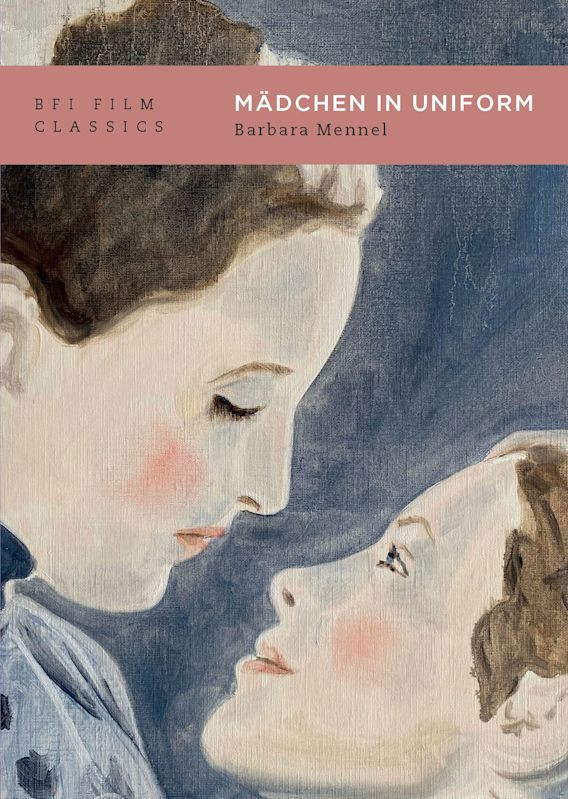
Girls in Uniform
For nearly thirty years, the British Film Institute has published its BFI Film Classics series, in which significant films are introduced, interpreted, and celebrated. Tara Prochaska read the volume on the German classic and milestone of queer film history, Mädchen in Uniform (Girls in Uniform).
A review by Tara Prochaska
At the start of the film, the protagonist Manuela von Meinhardis is sent to a Prussian boarding school for girls. There, she falls in love with one of the teachers, the caring Fräulein von Bernburg. After drunkenly declaring her love, she is punished by the school’s conservative headmistress. Manuela subsequently attempts to take her own life but is saved by her fellow students. This symbolizes a loss of power for the strict headmistress, who represents the oppressive traditionalism of the Weimar Republic.
Reception History
Author Barbara Mennel discusses the film’s central themes — female sexuality, friendship, and desire — across nearly a hundred pages. In doing so, she foregrounds above all the historical context and the reception history of the work. She explains how director Leontine Sagan, through a use of modern filmmaking methods that was nuanced for its time and through her depiction of female relationships outside patriarchal authority, critiques the political and social circumstances of the late Weimar Republic. Individual aspects that receive little screen time in the film itself — such as the representative function of architecture, the homoerotic undertones of the friendships, and the hierarchy of the boarding school as a reference to Prussian militarism — are further elaborated on by Mennel.
A Focus on Women
The book also engages with the diverse group of women involved in the production. The biographies of the cast and crew were shaped significantly by Mädchen in Uniform, but also by the Nazi seizure of power and the discourses surrounding the film under the Nazi regime. Through an analysis of various remakes, the book illustrates just how much the interpretation of the work has shifted alongside contemporary circumstances and different audiences. Controversies over censorship and inaccurate translations are also addressed. Through the sustained presence of various adaptations — such as the 1958 remake starring Romy Schneider — Mädchen in Uniform is attributed a certain timelessness.
Barbara Mennel’s book on Mädchen in Uniform offers deeper insight into the film’s complexity. Through its close engagement with the work’s contested reception history, the women involved in its making, and the film’s influence on modern pop culture, this slim volume is a wonderful addition and an informative homage to the film.