


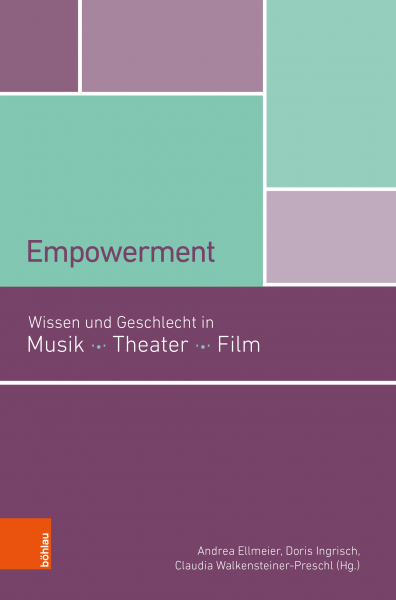
Queer-Feminist Empowerment
An edited volume on the significance of empowerment for queer-feminist communities has been published by the University of Music and Performing Arts Vienna (mdw).
A review by Anna Sacher
“We see that it is always a complex question what different people understand by empowerment” (p. 7), write Andrea Ellmeier, Doris Ingrisch, and Claudia Walkensteiner-Preschel in the introduction to their edited volume in the mdw Gender Wissen series. The fact that the concept of empowerment is currently just as prevalent in neoliberal and post-feminist contexts as it is in intersectional, anti-capitalist approaches within activism and academia opens up a wide field of tension. The volume’s contributions offer an overview of emancipatory understandings of empowerment, focusing on two key areas: gender diversity and anti-racism. In doing so, they draw on concrete initiatives in the German-speaking world that provide platforms for marginalized groups and/or individuals and that practically enact and interrogate empowerment.
Role Models and Trailblazers
The first two contributions begin by working on the conceptual foundations of empowerment. Drawing on her background as a Green Party member of the National Council, Faika El-Nagashi calls for a politicization of the concept of empowerment. Using the strategies of visibility, recognition, and appropriation within postcolonial and anti-racist contexts, she points, among other things, to local Viennese initiatives such as the research group on the Black diaspora in Austria. Luki Schmitz likewise lays groundwork for the concept of empowerment by questioning the understanding of subject, object, and resources outside of neoliberal-Western structures, situating this within the theoretical field of New Materialism.
The subsequent contributions to the volume focus increasingly on empowerment initiatives in the cultural sector, particularly in music. The festival “e_may” is presented, which pursues the goal of creating greater space and visibility for non-male musicians, composers, and curators in the music industry. The initiative “Musica inaudita” at the Berlin University of the Arts likewise works against an entrenched canon and toward a new (music) historiography. Ulli Mayer describes the Viennese “Pink Noise Camp” as an intervention in the pop-cultural music scene and as a space of empowerment for young, non-male music-makers. Mine Pleasure Bouvar Wenzel takes an autoethnographic approach to examining queer heterotopias and social spaces within the Berlin club scene. And Marko Kölbl casts a critical eye on the often-romanticized position of music as empowerment, focusing on Afghan music in the context of displacement.
Breaking Open Male Structures
Beyond the music scene, Bernadette Weigel points to the Austrian association “FC Gloria,” which advocates within the film industry for greater non-male visibility and equal treatment within film funding structures. Finally, Bettina Zehetner writes about her work as a psychosocial counselor at the association “Frauen* beraten Frauen*” (Women* Counsel Women*), highlighting in particular the formats of online counseling and writing in the organization’s work against violence toward women*.
Empowerment. Wissen und Geschlecht in Musik – Theater – Film is an academic volume that builds on a certain level of prior knowledge in the queer-feminist theoretical field, while requiring less background knowledge in music, theater, and film studies. Notable is the selection of authors, which draws not exclusively from an academic/institutional context but instead performatively takes up the idea of empowerment, allowing activists and/or researchers to write from the perspective of (their sometimes own) initiatives. The volume thus offers an interesting and enriching contribution to the discussion of the multifaceted concept of empowerment.